

Garshin's Exulansis
Exulansis. n. the tendency to give up talking about an experience because people are unable to relate to it.

Storytelling often serves two purposes: (i) to structure fictional or real events into a plot that emerges via the largely unorganised actions of heroes, villains, and everyone in between, and/or (ii) to project one’s inner heartspurs onto fictional archetypes who faithfully represent the fragmented characteristics of their host’s tortured psyche.
Most of my favourite fiction falls into the second category, including the short stories of Vsevelod Mikhailovich Garshin, a Russian author from the late 1800s. Sensitive, compassionate, and neurotic, much of his written work was marked by his experiences as a soldier in the Russian army, serving in the brutal Russo-Turkish War of 1877, which killed and displaced millions, and later in the Balkans campaign where he was wounded in action. He quit the army after the campaign ended, and embarked on what promised to be a successful literary career. However, Garshin only went on to author some twenty-odd short stories in a brief writing span that ended when he took his own life at the age of thirty-three. It is a tragedy, then, that an author’s own tragic story can oftentimes overshadow the message of their life’s work:
“How much suffering in one room, on one bed - and yet all this is merely one drop in the sea of sorrow and agony being experienced by an enormous number.”
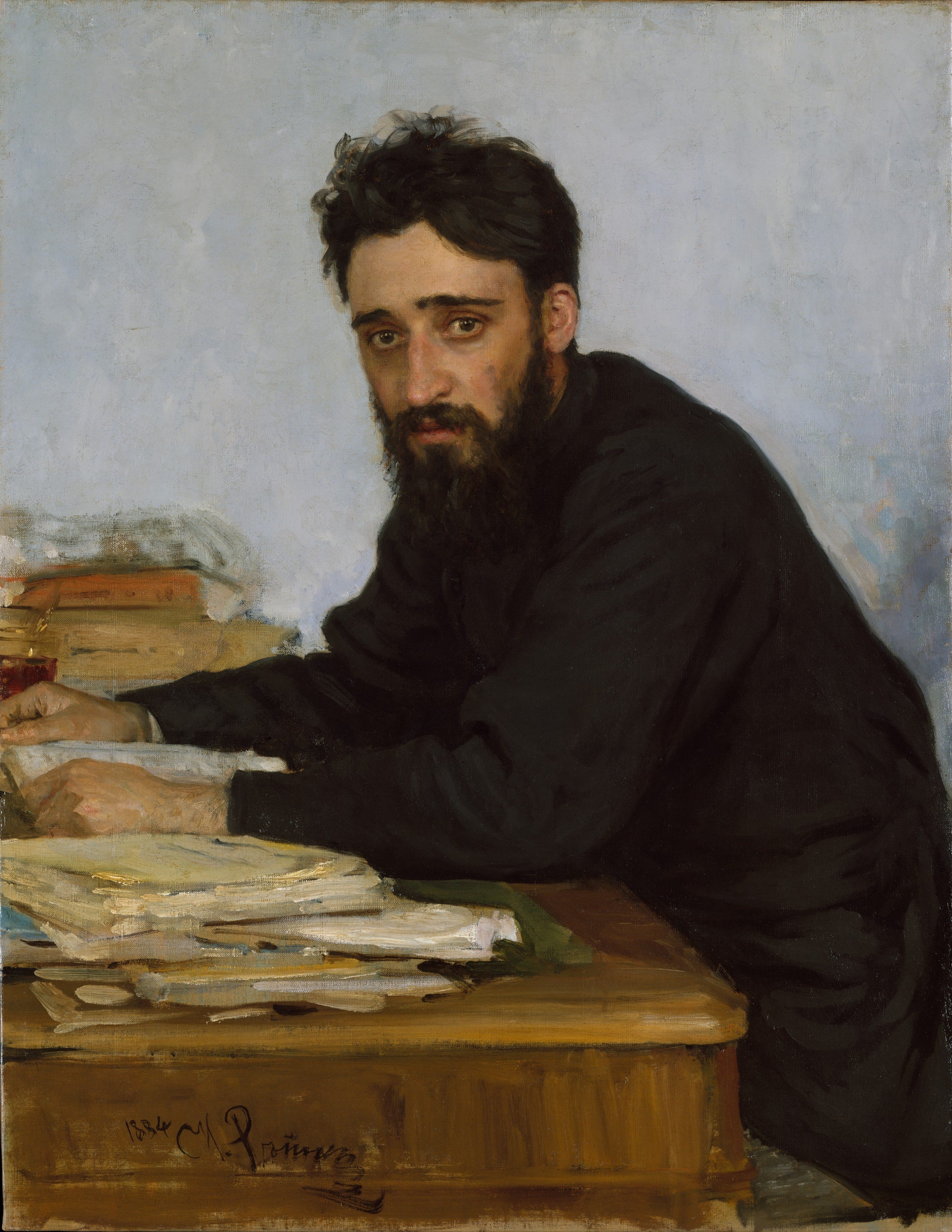
Garshin lived on the edge of tectonic global changes triggered by the Industrial Revolution, a decline in European imperialism and growing social unrest across the continent, which culminated in the great conflict of World War I. The dynamics of this period are not unlike the disturbed currents lurking underneath today’s societal fabric.
Garshin’s humble list of stories1 offers a powerful and heartwrenching account of life seen through the eyes of a melancholic mystic that will resonate with many. But a warning: I would NOT recommend Garshin’s stories to those unaccustomed to contemplating death, including their own.
Almost all of Garshin’s protagonists are versions of himself. In Coward, an unwilling young recruit, Vassili Petrovich, details his last night at home before heading to a war that he is vehemently against. Earlier in the story, Vassili ponders his horror at the quiet acceptance of the people around him of the numbers dying daily on the battlefield. Warned by others that he may be conscripted if the war drags on, Vassili wonders how he, a ‘kind-hearted young man who knows only his books and the labour of love and truth’, would fare in such evil circumstances. He realises, to his dismay:
“No kind of self-development, no self-knowledge, no knowledge of the world, no kind of spiritual liberty will give me physical liberty - the liberty to dispose of my own body.”
Inevitably, the day comes when Vassili is drafted:
“Well. It is all over. Now, I do not belong to myself. I shall go with the stream.”
"I am going with thousands of others to the brink of the world because history has need of my physical strength. As for intellectual forces - forget about them. No one wants them."
Many of Garshin’s protagonists meet their end, often at their own hands, foreshadowing the author’s own demise. One night, after a heavy bout of depression, Garshin threw himself off the staircase leading up to his apartment when his wife, who was keeping watch over him, stepped away for a few minutes. Anton Chekov, the esteemed playwright and physician, was called to the scene and, upon seeing the heavily injured body of his close friend, exclaimed: “An unendurable life! But a stairway… that is terrible. I saw it - dark, dirty.”2
It’s not surprising then that Garshin imposed a similar sorrow on his fictional characters. In A Night, Garshin details the excruciating last ruminations of Alexei Petrovich, who toys with a stolen revolver. He reflects on the words of an elderly cab driver who portends Alexei’s actions: “When work is hard and difficult, it is difficult to think much. But with you, sire, everything crowds into your head with ‘light’ food; with bread lightly earned. You wander around with wicked thoughts around you.”
Alone in his apartment, Alexei raises his revolver, pausing at the beatific sounds of the church bells, which bring joyful memories of childhood innocence before it was trampled upon by the tyranny of knowledge: “Red was red then, and not the reflection of red rays. Then everything was as it appeared.” With a renewed enthusiasm for life, Alexei sets aside his revolver only to notice his loaded weapon beside his corpse, wearing a peaceful, happy expression.
Many of Garshin’s stories highlight a certain admiration for an uncaring society and its human occupants who justify their hypocrisy as a mere fact of life. In The Meeting, a young teacher chastises an engineer who reveals his corrupt ways. The engineer mocks his more ethical friend:
“You cry about science and civilisation, but to what could it be applied if it were not for persons like me, people with means? That’s why a man has brains, in order to go astray.”
When pushed further, the engineer retorts,
“Will your work as a teacher turn out even one respectable man? Three-fourths of your pupils will become such as I am… I can picture you in a dressing gown, ten years from now, with a wife and seven children and no money with which to buy them shoes, breeches, hats. Prosaic.”
The most poignant story in Garshin’s collection, Attalea Princips, is almost charming and childlike, even in its sadness. It is told from the point of view of exotic tropical plants in a Russian greenhouse who, in vague recollections of their homelands, yearn for freedom and space. Some break through the glass confines, only to encounter a deathly embrace of the harsh Russian winter, and they slink back, allowing their human captors to restrict them even further.
Through these anthropomorphised plants, Garshin perfectly describes a growing resentment towards restrictive, dehumanising constructs that paradoxically are designed to keep most human beings alive for as long as possible. Many today are waking up to the price of the modern miracle of longevity, which has replaced the fear of death with a fear of living.
Garshin channelled his melancholy into a powerful expression of a spiritual force that has remembered its original source. His work challenges the notion of celebrating life for its own sake and is contemptuous of any commentary that glamourises humanity's struggle for existence as universally worthwhile. Garshin’s protagonists complete their hero’s journey upon realising their immortality and that their rage against a cruel world is synonymous with a rebellion against a demiurgic life force, a False God that can only create by destroying. Humanity conforms to smallness, allowing all sorts of cruelty in its unquenching thirst for life, which in its bare form is nothing more than a hedonic treadmill towards pleasure and away from pain. But we can make life more than that, Garshin suggests. We fall from grace every time we shirk away in fear of death, but the opposite is also true - we collectively rise towards the heavens when we embrace our mortality.
Though Garshin eventually lost faith in himself, his stories capture fleeting moments of his hope for a courageous humanity that sees past its internalised paternalism and directs itself towards the pursuit of a more enlightened society that can redefine life within its boundaries as not a prison sentence for its occupants but a privilege worth experiencing—a true heaven on earth.
The signal and other stories by Garshin, V. M. (Vsevolod Mikhailovich), 1855-1888. https://archive.org/details/signalotherstori00gars
Cavanaugh, Raymond. (2013). Vsevolod Mikhailovich Garshin. Br J Psychiatry. 202. 88. 10.1192/bjp.bp.112.116012.
"The pursuit of a more enlightened society that can redefine life within its boundaries as not a prison sentence for its occupants but a privilege worth experiencing—a true heaven on earth" - this conclusive sentence was, is and will be my religion. And the only tool for achieving this heaven is love! I am happy that these unheard-of authors are resusciated by you, Apra, across the veil of death so that their voices still live and resonate in life.